Objective
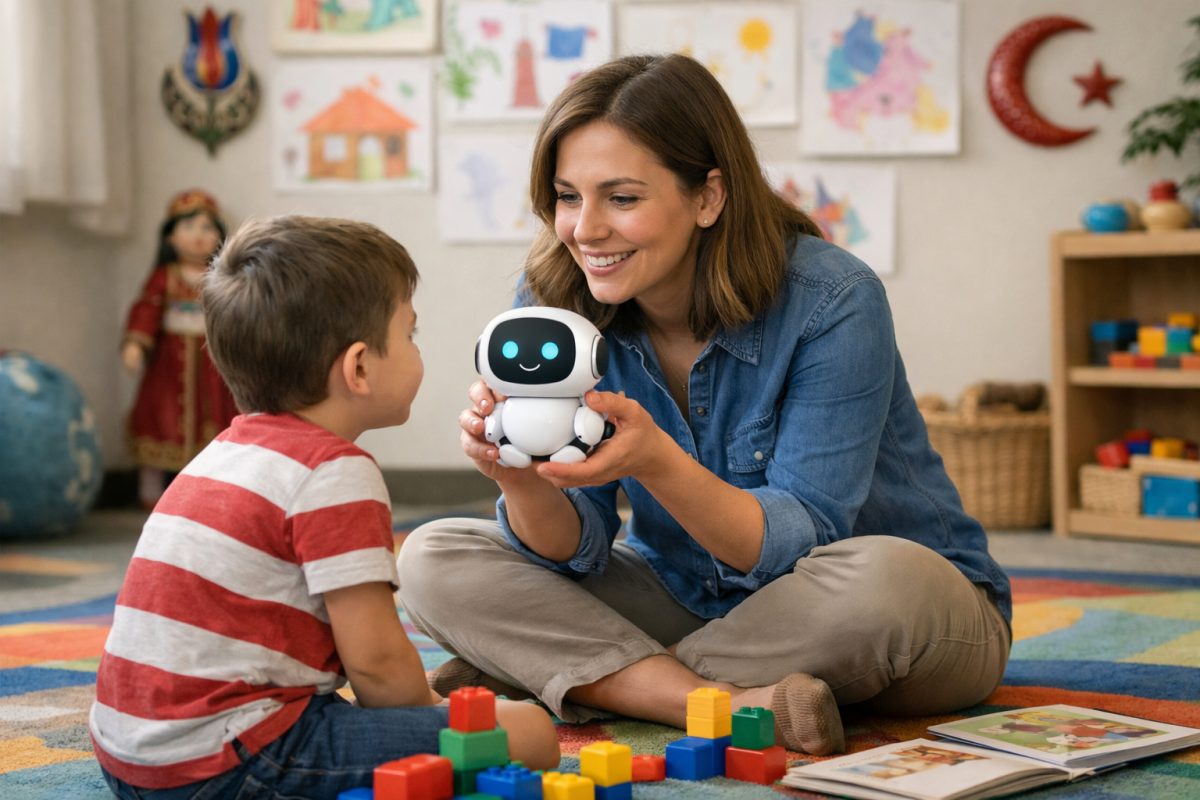
The study set out to understand how preschool teachers in Türkiye feel about artificial intelligence (AI) and what factors shape their attitudes. As AI becomes more common in education, teachers' openness to using it in early childhood classrooms is important for how these technologies are adopted. In Türkiye, AI use in preschools is still new, and little is known about how teachers view its benefits and risks. The researchers wanted to know if attitudes toward AI differ by teachers' age, gender, education, region, professional experience, type of school, digital skills, internet use, and training in educational technology. They also looked at whether using AI tools like ChatGPT or taking technology courses is linked to more positive attitudes. The main research questions were:
- What are preschool teachers' attitudes toward AI?
- Do these attitudes differ by demographic factors (like age, gender, education, region, experience, school type)?
- Do attitudes differ by behavioral factors (like prior technology training, daily internet use, frequency of AI tool use, and digital competence)?
- Are attitudes related to age, frequency of AI tool use, and digital technology skills?
The study used the Technological Pedagogical Content Knowledge (TPACK) and Technology Acceptance Model (TAM) as frameworks to help interpret the results. TPACK looks at how teachers combine technology, teaching methods, and subject knowledge. TAM suggests that people are more likely to use technology if they find it useful and easy to use.
Methods
This was a quantitative survey study using a relational survey model, which looks for links between variables but does not show cause and effect. The researchers collected data from 405 preschool teachers working in public and private schools across all seven regions of Türkiye during the 2024–2025 school year. The sample included 285 women (70.4%) and 120 men (29.6%), with an average age of about 35 years. Most teachers had a bachelor's degree (75.56%), and the majority worked in public schools (81%). Teachers' professional experience ranged from 1 to over 20 years, and all regions of Türkiye were represented, with the largest group from the Aegean Region (21.73%).
Data were collected online using Google Forms. Two main tools were used: a demographic questionnaire and the General Attitude Scale Toward Artificial Intelligence (Kaya et al., 2022). The attitude scale has 20 items (12 positive, 8 negative) rated from 1 (strongly disagree) to 5 (strongly agree). Negative items were reverse-coded so higher scores always meant more positive attitudes. The scale's reliability was high (α = .88 for positive, α = .83 for negative subscales).
Teachers answered questions about their gender, age, region, education, years of experience, school type, prior technology training, daily internet use, frequency of AI tool use (such as ChatGPT), and digital technology competence. Participation was voluntary and anonymous. The study received ethics approval from Dokuz Eylül University (Document No: E-87347630–659-1,156,722).
For analysis, the researchers used descriptive statistics (means, standard deviations, frequencies) and inferential statistics (t-tests for two groups, ANOVA for more than two, and bivariate correlation for continuous variables). They checked for normality using graphs and statistical tests, and set the significance level at .05. The study focused on relationships between variables, not on proving causation.
Key Findings
The main finding was that preschool teachers in Türkiye generally reported positive attitudes toward AI, but these attitudes varied by several factors.
Overall attitudes
- The average general attitude score toward AI was 3.27 out of 5 (SD = 1.05), showing a positive tendency.
- Positive attitude subscale mean was 3.37 (SD = 1.11). Teachers most agreed that AI could offer new economic opportunities (mean = 3.73), they would like to use AI in their work (mean = 3.66), and that AI has many useful applications (mean = 3.65).
- Teachers least agreed with preferring to interact with AI over humans for routine tasks (mean = 2.65), showing a strong value placed on human interaction in early childhood education.
- The negative attitude subscale (reverse-coded) mean was 3.16 (SD = 1.08), suggesting teachers were not strongly worried about AI dangers or ethical concerns. They did not see AI as malevolent or as a surveillance threat.
Demographic differences
- Gender: No significant difference in attitudes by gender (female mean = 3.29, male mean = 3.21, p = .53).
- Education level: Significant difference (F(2,402) = 154.99, p < .01, η2 = 0.43). Teachers with a master's degree had much higher attitude scores (mean = 4.13, SD = 0.68) than those with a bachelor's (mean = 3.33, SD = 0.85) or associate degree (mean = 1.20, SD = 0.40).
- Region: Significant differences (F(6,398) = 20.67, p < .01, η2 = 0.23). Teachers in Southeastern Anatolia had the lowest scores (mean = 2.16, SD = 1.04), while Central Anatolia and Marmara had the highest (means = 3.84, SD = 0.60 and 0.83).
- Professional experience: Large difference (F(3,401) = 134.09, p < .01, η2 = 0.51). Teachers with 1–5 years' experience had higher scores (mean = 3.88, SD = 0.62) than those with 11–20 years (mean = 3.25, SD = 0.77) or over 20 years (mean = 2.05, SD = 0.97).
- School type: Teachers in private schools had higher scores (mean = 3.60, SD = 0.60) than those in public schools (mean = 3.19, SD = 1.13, t(403) = 3.07, p < .01, Cohen’s d = 0.39).
Behavioral and skill-related differences
- Daily internet use: Significant difference (F(2,402) = 98.14, p < .01, η2 = 0.33). Teachers using the internet 3+ hours/day had higher scores (mean = 3.67, SD = 0.57) than those using it 1–3 hours (mean = 3.46, SD = 0.88) or 1 hour or less (mean = 1.77, SD = 1.12).
- Instructional technology course: Large difference. Teachers who had taken a course had much higher scores (mean = 3.70, SD = 0.69) than those who had not (mean = 1.95, SD = 0.91, t(403) = –20.14, p < .01, Cohen’s d = 2.60).
Correlations
- Age: Significant negative correlation (r = –0.71, p < .01). Younger teachers had more positive attitudes.
- Frequency of AI tool use: Strong positive correlation (r = 0.76, p < .01). More frequent users of AI tools like ChatGPT had more positive attitudes.
- Digital technology competence: Positive correlation (r = 0.66, p < .01). Teachers who rated their digital skills higher also had more positive attitudes toward AI.
Other findings
- Teachers valued human interaction highly, even for routine tasks, and saw AI as a complement, not a replacement, in early childhood education.
- Attitudes were shaped by both demographic and behavioral factors, and the study found that looking at both gives a clearer picture of what influences openness to AI.
Implications
For teachers: The results suggest that teachers who are younger, have higher digital skills, use the internet more, or have taken technology courses are more open to using AI in their work. Teachers who want to feel more confident about AI could benefit from targeted training or professional development, especially if they have less experience with technology.
For school and university leaders: The findings point to the need for professional development programs focused on AI, especially for older or more experienced teachers and those in regions with lower attitude scores. Leaders should consider offering more technology training and support in public schools and less developed regions. Providing access to digital tools and internet resources may help close gaps in attitudes and readiness.
For policymakers: The study shows that regional and institutional differences affect openness to AI. Policymakers could invest in digital infrastructure and targeted training in regions with lower scores, and ensure that teacher education programs include AI and technology integration. Expanding TPACK-based and AI-focused content in teacher training could help prepare future educators.
For researchers and developers: The strong links between digital competence, training, and positive attitudes suggest that future research and tool development should focus on making AI tools easier to use and more relevant to teachers' daily work. Developers should involve teachers in design and provide clear, practical training materials.
Our reading (not the authors' recommendation): Teachers who have not taken technology courses or who use the internet less may need extra support to feel comfortable with AI. Schools and policymakers could consider mentoring or peer support systems for these teachers. However, since this study is correlational, these suggestions should be tested in future research.
Limitations
The authors note several limitations. First, the attitude scale used was abstract and did not include examples specific to early childhood education, so teachers may have interpreted some items differently. This could affect how well the results reflect real classroom attitudes. Second, the large effect sizes and strong correlations (such as Cohen's d = 2.60 for prior technology course, r = 0.76 for AI tool use, r = –0.71 for age) may reflect sample characteristics, such as polarization between teachers who have and have not received technology training, or self-selection (teachers interested in technology may have been more likely to participate). The paper does not mention, but the use of self-reported attitudes rather than observed behavior means that results may not show how teachers actually use AI in classrooms. The study was limited to Türkiye, so results may not apply elsewhere. The paper does not mention, but as a cross-sectional survey, the study cannot show cause and effect, only links between variables. The paper does not mention, but online data collection may have excluded teachers with less digital access or skill, possibly biasing the sample.
Future Directions
The authors suggest several areas for future research. They recommend using qualitative follow-up questions or scenario-based items to better understand how preschool teachers interpret AI-related concepts in their own classrooms. Future studies could look at how attitudes and actual use of AI change over time (longitudinal research), and compare results across countries or educational levels. The authors also suggest evaluating teachers' technology integration skills and pedagogical design capacities using frameworks like TPACK or TAM, not just attitudes. More research is needed to see if the strong links found in this study appear in other contexts or with different samples. Finally, future work could explore which types of AI applications teachers find most useful and how they balance AI use with the need for human interaction in early childhood education.
The bottom line: Preschool teachers in Türkiye generally reported positive attitudes toward artificial intelligence, especially those who are younger, have more digital skills, use AI tools often, or have taken technology courses. Attitudes were less positive in some regions and among teachers with less training or lower internet use. No difference was found by gender. The study's large sample and national coverage strengthen its findings, but results are based on self-reported attitudes and cannot show cause and effect. Training and support may help close gaps in readiness for AI, but more research is needed to understand how attitudes translate into classroom practice.


Comments 0
No comments yet. Be the first to share a thought.
Get new research summaries by email
Every new summary each morning, a weekly digest, or a monthly report. You choose, and you can unsubscribe in one click.