Objective
This study set out to understand how primary school students behave and interact with generative AI (GenAI) during creative problem-solving activities. The researchers wanted to know what students actually do at each stage of a group project when using GenAI, and whether students who perform better show different patterns than others. Creative problem-solving (CPS) means coming up with new and useful solutions to complex problems. GenAI tools, like large language models and text-to-image generators, can help students brainstorm ideas, give feedback, and refine their work. But little is known about how younger students use these tools in real group tasks, especially compared to older students or adults. The study focused on three main questions: (1) What kinds of behaviors do primary students show in GenAI-supported CPS? (2) How do the sequences of these behaviors differ between high- and low-performing groups? (3) How do the quality and depth of their interactions with GenAI differ between these groups?
Methods
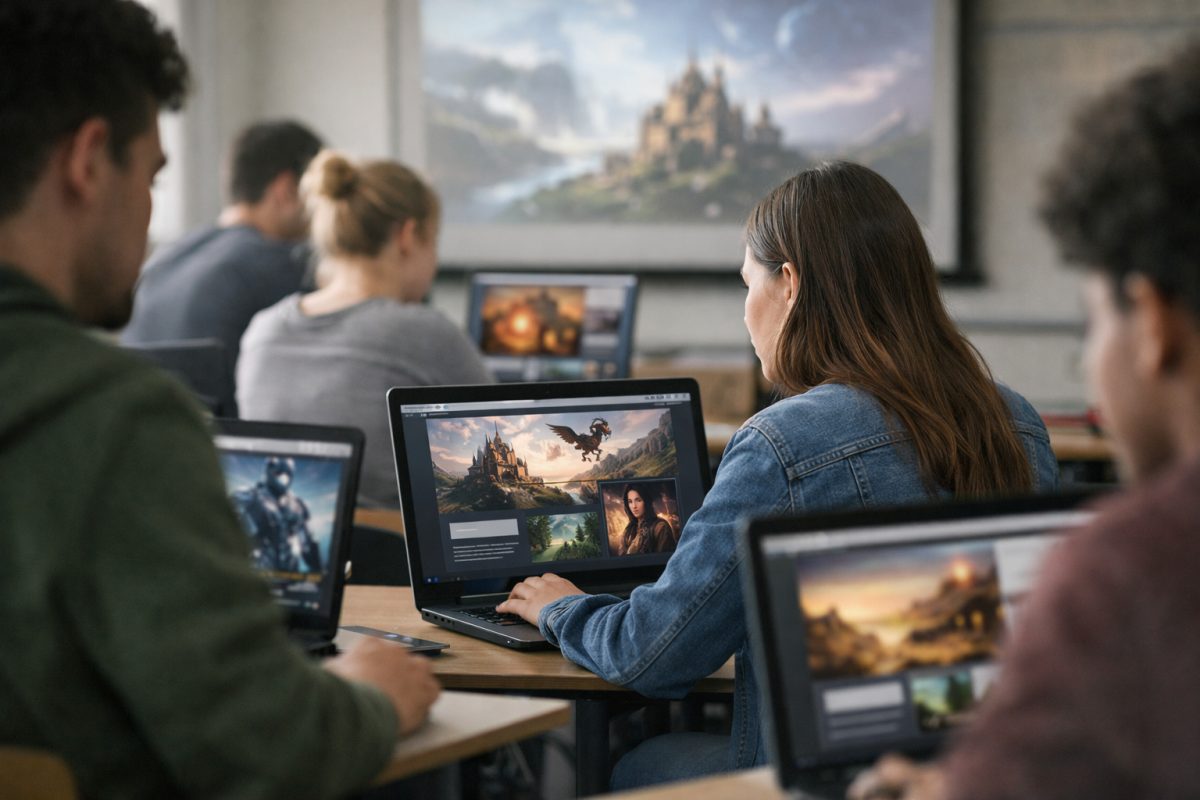
The study took place in the fall of 2025 at a public primary school in eastern China. Students from grades 4 to 6, with a mean age of 11 years, were selected based on their prior experience using GenAI tools and creating digital artifacts. They were divided into six mixed-grade groups, each containing students from grades 4, 5, and 6. The study was run as a five-day extracurricular program on campus, led by an experienced IT teacher.
Students used a custom GenAI-supported system called Campus Spirit. This system included preset buttons for prompts (such as 'Idea Booster'), text-to-image generation, and feedback features. Students interacted with GenAI mainly through text, using both open-ended dialogue and preset prompts. The GenAI models used included Qwen-Turbo for text, Wan2.2-T2I-Flash for images, and others for feedback and editing.
The program included both theory and practice sessions. On the final day, groups worked together on a project called “Introducing My School to the World,” creating digital artifacts to present their school. Data collected included the digital artifacts, screen recordings of group work (12 recordings, 135 minutes each), and chat logs between groups and GenAI. The researchers rated each group’s final artifact on originality, scientific accuracy, diversity, and aesthetics, using a 1–5 scale for each area (maximum 20 points). Groups were split into high-performing (HPGs, top 3) and low-performing (LPGs, bottom 3) based on these scores.
Researchers coded student behaviors in 10-second intervals, focusing on four CPS stages: problem identification, idea generation, solution validation, and solution optimization. They used descriptive statistics, lag sequential analysis (to see behavior patterns over time), and epistemic network analysis (to study the depth and quality of GenAI interactions). Two coders rated the data, with high agreement (Cohen’s Kappa = 0.88 for behaviors, 0.75 for interaction coding). The study was approved by an ethics committee, and informed consent was obtained.
Key Findings
Overall behavioral patterns
- Students spent most of their time in the solution validation stage (64.4% of behaviors), followed by idea generation (27.4%), problem identification (4.6%), and solution optimization (3.6%).
- The most common actions were adjusting layout (15.1%), adding or modifying text (12.3%), entering prompts into GenAI (11.0%), inserting shapes (9.7%), copying materials (9.3%), adjusting text (8.5%), and reading GenAI feedback (7.9%).
- Students paid little attention to clarifying requirements (0.9%), uploading for GenAI evaluation (0.5%), reading GenAI evaluation (1.6%), and revising solutions after feedback (1.5%).
Differences between high- and low-performing groups
- High-performing groups (HPGs) showed clearer goals and more organized, step-by-step behavior. For example, they usually clarified requirements before sketching ideas and followed a logical sequence when using GenAI: selecting a role, entering prompts, reading feedback, comparing options, and choosing materials.
- HPGs were more likely to download and use GenAI-generated materials, and to revise their artifacts after GenAI evaluation. The paper gives counts for some actions, such as downloading materials (HPGs = 162; LPGs = 92) and layout actions (HPGs = 513).
- Low-performing groups (LPGs) had more scattered and repetitive behaviors. They often switched between GenAI roles, entered prompts repeatedly, and did not follow a clear sequence. They downloaded fewer materials and made fewer revisions after feedback.
- In the solution validation stage, HPGs focused on integrating layout and maintaining visual coherence, while LPGs spent more time inserting and adjusting shapes.
Interaction qualities with GenAI
- HPGs were more likely to ask medium- or deep-level questions and use GenAI’s feedback to refine their work. Their interactions often followed a pattern: ask a thoughtful question, get task-based feedback, and then use heuristic (guiding) feedback for further improvement.
- LPGs tended to ask more superficial questions and focused on immediate results. Their interactions were more about getting quick answers or using GenAI’s role-based feedback, rather than engaging in deeper inquiry or iterative improvement.
- Statistical tests (Mann–Whitney U) found no significant difference in overall interaction quality between HPGs and LPGs, but network analysis showed that HPGs had stronger links between deep inquiry and feedback use, while LPGs had stronger links between shallow inquiry and role-based feedback.
In summary, students who set clear goals and engaged in deeper questioning made better use of GenAI, both in process and in final products. Those with less clear goals used GenAI more as a quick tool and did not build on its feedback as much.
Implications
For teachers: The results suggest that primary students need more than just access to GenAI tools. Teachers should provide clear scaffolding, such as task sheets and guiding prompts, especially at the start of a project. Helping students clarify goals and requirements can strengthen the early stages of problem-solving. During the revision stage, teachers can encourage students to use GenAI’s feedback for iterative improvement, not just for quick fixes.
For school leaders and curriculum designers: Programs that combine GenAI with teacher guidance may help students develop both creative and self-regulation skills. The study suggests that GenAI alone is not enough to support all stages of creative work. Structured support is needed, especially for students who may not naturally set clear goals or reflect on feedback.
For students: Learning to ask thoughtful questions and use feedback to improve work is key to getting the most from GenAI. Treating GenAI as a collaborative partner, not just a tool for quick answers, can lead to better results.
For developers: GenAI systems for education should include features that support deeper inquiry and provide feedback that adapts to the student’s level of questioning. Systems could prompt students to reflect on their questions and guide them toward more strategic use of the tool.
Our reading (not the authors' recommendation): Schools considering GenAI for creative group work should combine it with teacher-led scaffolding and activities that build students’ questioning and self-regulation skills. Relying on GenAI alone may not help all students, especially those who struggle with goal-setting or reflection.
Limitations
This study has several limitations that affect how widely the results can be applied. First, the research was conducted in a single primary school in eastern China, and only included students from grades 4 to 6 who already had experience with GenAI and digital artifact creation. The small sample size and specific context mean the findings may not generalize to other schools, age groups, or countries. Second, the program lasted only five days, which may not be enough to see long-term effects or deeper learning changes. Third, the analysis focused on group behaviors and did not examine individual student differences within groups, which could hide important variation in how students interact with GenAI. The paper does not mention, but relying on screen recordings and chat logs may miss some off-screen or unspoken group dynamics, such as verbal discussions or nonverbal collaboration. The study also did not include a comparison group working without GenAI, so it cannot show whether GenAI itself caused the observed differences. Finally, the findings are based on one specific creative task (introducing the school), so results might differ for other types of projects or subjects. These factors mean that readers should be cautious in applying the results to other settings or assuming similar outcomes elsewhere.
Future Directions
The authors suggest several areas for future research. Studies with larger and more diverse samples are needed to see if the findings hold in other settings or with different age groups. Research could also look at both group and individual behaviors to understand how students with different skills interact with GenAI, since this study only analyzed group-level actions. Adding other types of data, such as eye-tracking or physiological measures, could give a fuller picture of how students engage in creative problem-solving with GenAI and capture aspects missed by screen recordings. Future work could also test different types of scaffolding or feedback to see what best helps students use GenAI effectively at each stage of a creative project. The study leaves open questions about how long-term use of GenAI might affect students’ creative and self-regulation skills, and whether similar patterns would be seen in other subjects or types of group work.
The bottom line: When primary school students use GenAI for creative group projects, those who set clear goals and ask deeper questions make better use of the tool and produce stronger results. Groups with less focus tend to use GenAI more superficially and do not build on its feedback. However, this study was small and limited to one school and one type of task, so the findings may not apply everywhere. Teachers and schools should combine GenAI with structured support and activities that build students’ questioning and self-regulation skills, rather than relying on the technology alone.


Comments 0
No comments yet. Be the first to share a thought.
Get new research summaries by email
Every new summary, daily at 8:00 AM Eastern (or weekly if you prefer). Unsubscribe in one click.