
Objective
Young children are growing up around voice assistants, smart toys and chatbots. Researchers already know that from about age 3, children do not trust every adult equally. They tend to favor people who are familiar and who have been right before. This skill, called selective trust, helps children learn from others while filtering out bad information. What is not well understood is how preschoolers decide whom to trust when an AI-style voice and a caregiver disagree.
The authors wanted to build and test a way to study this at home. They used event-segmentation theory, which says people mentally break a continuous experience into separate events. The points where one event ends and another begins are called event boundaries. The authors guessed that at these moments a child might feel less sure about what is happening and might therefore lean more on an outside source, including an AI voice.
This was a small proof-of-concept pilot, meant to check whether the method works before a larger study. The paper sets three aims:
- Check whether the test can be run in a real home with a 3-year-old.
- See whether the measures produce answers that can be interpreted.
- Find design problems that should be fixed before a bigger study.
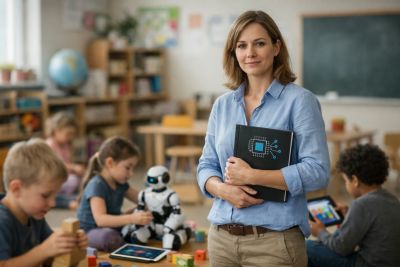
The "AI" in this study was not a live chatbot. It was a robot picture card paired with a pre-recorded voice, which the paper calls an AI-framed artificial informant.
Methods
This was a single-case pilot study: one child, tested in one session. This kind of study can show whether a procedure is practical and can point to problems, but it cannot show what children in general do. The researchers followed a reporting guideline for single-case studies called SCRIBE 2016.
Who took part
One boy aged 3 took part at home with a primary caregiver beside him. The caregiver gave informed consent. The University of Granada research ethics committee approved the protocol (approval number 4948/CEIH/2025). According to the caregiver, the child had only minimal contact with AI: no smart speaker, no smart toys and no past conversations with a generative AI system, only a few minutes a week of voice interfaces on a parent's phone.
What the child did
The child watched a 2:04 clip from the cartoon Bluey (Season 1, Episode 1, "Magic Xylophone"), shown with a portable projector. The clip was paused four times. Two pauses fell at event boundaries, such as a scene change, and two fell at control moments in the middle of a scene. At each pause the child did three tasks:
- Segmentation: the child said whether the same thing was still happening or something new had started.
- Prediction: the child chose between two options for what would happen next.
- Deference: the caregiver and the robot gave opposite predictions, and the child touched a card showing the person or the robot to choose whom to follow.
The robot was right at both boundary pauses and the caregiver was right at both control pauses, so each was right 2 of 4 times overall. This was done so that one informant would not simply look more reliable over time. The robot voice was a recorded adult voice, played at the same volume each time. The caregiver read scripted lines, kept a neutral face and did not point or react to the child's choice.
How it was analyzed
With one child and four trials, the researchers only counted and compared choices. They coded hesitation from video as a delay of 2 seconds or more, or looking back and forth between the cards. The first author set the pause points and coded hesitation, with no second coder.
Key Findings
The test could be run from start to finish with a 3-year-old at home, but the child's choices are too few to say anything general about children and AI.
Feasibility
- All 4 of 4 trials were completed, and no planned data were missing.
- The session took about 5 minutes, and the researchers considered that within a young child's attention span.
- The plan to have each informant be right 2 of 4 times was carried out as designed.
Who the child chose to follow
- Across the four pauses, the child followed the robot, then the robot, then the caregiver, then the robot. That is 3 of 4 choices for the robot.
- At the two event-boundary pauses, the robot was chosen once out of two times. At the two control pauses, the robot was chosen both times.
- The authors had predicted the opposite: more trust in the AI at boundaries. The pilot did not support that prediction, but the authors stress that two trials per condition is far too few to read anything into this difference.
- Hesitation was seen only at the first pause, which was the first boundary.
Attention dropped in the second half
- Segmentation answers were right in both first-half trials (2 of 2) and in neither second-half trial (0 of 2).
- Prediction answers followed the same pattern: perfect in the first half and none right in the second half.
- The authors read this as a sign of tiredness or lost attention, which means the child's choices at the last two pauses may not reflect real thinking about whom to trust.
Why the boundary comparison cannot be trusted
Boundary pauses always came first and third, and control pauses second and fourth. So any difference between them is mixed up with the order of the trials. The child may have been drawn to the new robot at the start, may have reacted to the robot's recent mistake, or may have grown tired. The paper offers several ideas, none tested:
- The robot may attract a young child simply because it is new.
- The single choice of the caregiver came right after the robot had given a wrong prediction earlier, which may mean the child weighs recent mistakes heavily.
- The child's own sense of where a boundary falls may differ from the researchers' coding.
The authors call these hypotheses for future testing, not findings.
Implications
The main audience for this paper is researchers, and the authors make no practical claims for classrooms. Nothing here shows how preschoolers in general respond to AI. Still, a few careful readings are possible.
For researchers and developers
- The authors recommend a larger study with 2 pauses per child, one boundary and one control, with different children in each condition. This removes the order and tiredness problems seen here.
- They suggest a short get-to-know-the-robot phase first, so novelty matters less.
- They suggest measuring how long a child takes to answer, not just a yes-or-no hesitation mark, and having a second person code the video.
- They propose a pre-registered plan (a public plan written before data are collected) and a sample of about 130 children, roughly 65 per condition.
For parents and teachers
This single case should not guide choices about AI toys or assistants. It is a sensible reading, not a recommendation from the authors, that a child who is new to AI may be drawn to it, and that adults can watch how young children respond when an AI voice and a trusted adult give different answers. The authors also point to concern that confident-sounding AI may weaken children's habit of checking sources, but this pilot does not test that.
For policymakers
The evidence is far too thin to support any rule or guidance. The paper does say that understanding when young children defer to AI is a developmental and societal issue, which supports funding larger studies.
What to watch out for
Because the AI here was a recorded voice, findings may not carry over to live chatbots that answer back.
Limitations
The authors are open about the limits of this pilot, and readers should hold the results loosely.
- One child. With a single participant, nothing can be generalized. The child's choices may reflect his own personality, mood or home life.
- Trials mixed with order. Boundary trials always came at pauses 1 and 3, and control trials at 2 and 4. The boundary-versus-control difference cannot be separated from novelty, recent feedback, tiredness or lost attention.
- Very few trials. Four trials, two per condition, cannot be told apart from chance. The authors did not run statistical tests for this reason.
- Attention loss. Segmentation and prediction answers fell from perfect to none in the second half, so the later choices may not mean much.
- Coding by one person. The first author set the boundary points and coded hesitation, with no blind or second coder, and measured only yes-or-no hesitation, not response time.
- Not a real AI. The informant was a robot card with a pre-recorded voice, so results speak to a stylized voice agent, not a live generative AI.
The paper does not mention, but the child was shown a cartoon, and responses to AI may differ in learning situations such as school tasks. The paper also does not say whether the child understood the robot to be an AI.
Future Directions
The authors lay out a clear plan for the next study and several open questions.
- Does a larger study, with about 130 children split between a boundary condition and a control condition, find that young children defer to AI differently at event boundaries?
- Does a short familiarization with the robot reduce the pull of novelty?
- Do children weigh the most recent mistake of an informant more than the full record of right and wrong answers?
- Does a child's own sense of where a boundary falls, rather than the researchers' coding, better predict who the child trusts?
- Would recording response time continuously show degrees of conflict that a yes-or-no hesitation mark misses?
- Would two pauses per child avoid the fatigue seen here?
The authors also plan to pre-register hypotheses and the analysis plan, and to use independent, blind double coding. The paper gives no plans for testing live generative AI, though that remains an open question given its limitation about the pre-recorded voice.
The bottom line: This paper describes a test built to see how a young child chooses between a caregiver and an AI-framed robot, and tries it on one 3-year-old. The test could be run at home in about 5 minutes, and the child picked the robot in 3 of 4 disagreements. But with one child, four trials and the trial order mixed up with the conditions, the results say nothing about children in general. The most useful lessons are about design: fewer pauses per child, a robot warm-up and better timing measures. Treat it as a first step toward a larger study, not as evidence about children and AI.


Comments 0
No comments yet. Be the first to share a thought.
Get new research summaries by email
Every new summary, daily at 8:00 AM Eastern (or weekly if you prefer). Unsubscribe in one click.