
Objective
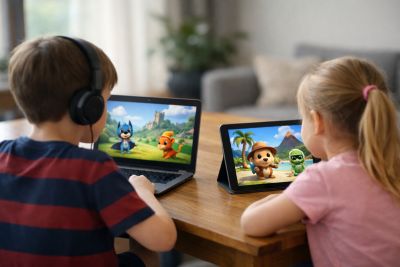
Young children now see adults using generative AI at home, and some use it themselves, at home and at kindergarten. Generative AI (GenAI) is software that produces text, speech or images in response to a request. Conversational AI is a type of GenAI that talks back in everyday language. Because a child can speak to it, there is no need to type or read, so even children who cannot yet read can use it. Most research so far has asked adults or teachers about AI. Little of it has watched young children use it directly.
The researchers did not set formal research questions. They wanted to explore the following:
- What kindergarten children know about a popular Chinese chatbot called Doubao, and what they can do with it.
- Whether, and how, children move into a conversation with the chatbot while a teacher is in the room with them.
- Whether short, informal conversations are a good way to learn what young children know about AI.
The paper uses neo-ecological theory, which says a child can be present in two settings at once: the physical classroom and a virtual space on a device. It treats the chatbot as a "Person" in the virtual space because it talks with the child. This does not mean the authors think the chatbot is human. They expected the younger children to know less than the older ones.
Methods
This was an exploratory, qualitative study. That means the researchers described what children said and did in detail instead of measuring it with numbers. This kind of study is good for seeing how something works in practice, but it cannot show how common a behavior is or whether a tool causes a result.
Who took part. The study took place in a kindergarten in Shanghai, China, in September and October at the start of the 2025 to 2026 school year. The children came from the second year of kindergarten (called K2, ages 4 to 5) and the third year (K3, ages 5 to 6). The researchers grouped children by gender and picked them in random order, then asked parents for consent until they had 8 girls and 8 boys in each year. That gave 32 children. Each child also gave assent, and no child declined. The sample was a convenience sample, so it is not meant to represent all children.
What happened. The first author, who teaches at the kindergarten, held a short, informal, semi-structured interview with each child in the classroom during regular routines. Each lasted no longer than 10 min. She asked how the child knew about Doubao, what children need to know to use it, whether and how often they had used it, and what they ask it. She then invited the child to show how they use it on a smartphone and to ask anything they liked. Nine children did not know what Doubao was and were not interviewed. Two more said they did not know it but described using other chatbots, so their data were kept. That left 23 children in the analysis.
Data and analysis. Talks were audio recorded, transcribed, translated from Chinese to English with the help of an AI model, and checked by the first author. She also took fieldnotes on gestures and eye gaze. The two authors coded the material together using reflexive thematic analysis, a method in which researchers openly use their own judgment to find themes. They produced 235 codes from the transcripts and 75 from the fieldnotes, trimmed to 303. An AI assistant then helped group the codes into nine patterns and three themes, while the authors checked and led each step. The study had ethics approval, and names were replaced with child codes.
Key Findings
Children's experience with Doubao varied a great deal, and the adult in the room shaped how the conversations went. The findings come from interviews and observations, so they describe these children and do not measure effects.
Who knew Doubao
- All 32 children with parental consent agreed to talk. Nine did not know what Doubao was, so 23 were interviewed.
- Most boys and girls said they had not used Doubao before. More boys than girls had used it "sometimes", and more girls than boys had used it "many times".
- Knowledge ranged from none to advanced. One child showed how to prompt Doubao to make videos and criticized the result.
- Children's first questions often matched what they were learning: K2 children had been learning about autumn and K3 children about Shanghai.
Theme 1: A teacher helps children get in
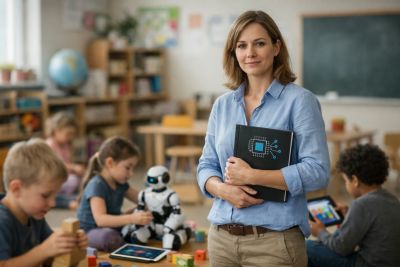
- Most children entered the chatbot conversation with help from the adult beside them. She found the app, turned on the sound, showed voice input, suggested questions and asked what they understood.
- Children often looked to the adult for a nod or a smile before taking another turn with the chatbot.
- Some children moved fast from hesitant, adult-guided use to confident, independent use. One girl frowned at an unrelated answer, then rephrased her question and smiled when she got a better answer.
- Doubao's answers were often long and complicated, and children rarely questioned them unless the adult prompted them. In one case a child asked if dumplings come from Shanghai and got an answer that did not fit, and only after the teacher asked did she try again with a clearer question.
Theme 2: Children in two places at once
- Some children talked to the chatbot and the teacher in the same breath, such as whispering a riddle answer to the teacher and then saying it aloud to Doubao.
- Others relayed what Doubao said to the teacher afterward, which made the exchange more like taking turns than a shared conversation.
Theme 3: Is it a person or not
- Some children seemed to treat Doubao like a person. One K2 boy said you need to ask questions and "be polite". A K3 girl called it "a pretend person you can chat with".
- Doubao's friendly style did not always match a child's. A child said a short sentence about eating ice cream at Disney and got back a long reply with several questions.
- Children noticed the mismatch, asking "Why are there so many words" and why the chatbot had not replied yet. One weather question got a long answer about California.
The authors found little evidence that children's exchanges grew more complex over time, but each child was seen only once.
Implications
The authors draw these lessons, and a few points below are the cautious readings of the results.
Teachers
- The authors say teachers should first find out what each child already knows, since experience varied widely and came largely from home.
- They argue that teachers need to be present in both the classroom and the chatbot conversation, helping children judge answers, notice that the chatbot does not truly understand feelings, and avoid treating it as a person.
- Small groups with a teacher would suit this work, though the authors note that class sizes may make that hard.
- A sensible reading: a teacher's reactions matter. The first author saw that even a neutral "mm" could seem to confirm a child's belief that Doubao can solve every problem.
Leaders and curriculum developers
- The authors point out that educators may be underprepared for children who arrive already used to AI, so professional learning is a priority. They suggest that an existing review of AI literacy from kindergarten to Year 12 could be a starting point for planning.
Developers
- The authors say developers should avoid designs that encourage young children to treat chatbots as people. Long answers, delays and uneven turn lengths made the chatbot feel less human here, which may be a protection for now, not a plan.
Parents and families
- The paper does not give advice for parents directly, but its findings suggest that an adult who sits with a child and asks "did that answer your question?" is useful.
The evidence is too thin to say which teaching approach works best, since the study did not test any approach.
Limitations
The authors say the data are a snapshot of what children showed during one short visit. The interviews were brief, so the researchers could not see whether a child's conversations with the chatbot became more complex over time, which is a key idea in the theory they used.
The sample was a convenience sample from one kindergarten in one city, so the results cannot be generalized to other children. The authors also mention the AI divide, meaning that access to AI differs between families. Two children were included who did not know Doubao but knew other chatbots, and the authors think more children might have joined if they had asked about "technology like Doubao".
The recordings were audio only. Gestures, eye gaze and tone of voice carry a lot of meaning for young children, and these were captured only in the first author's fieldnotes. The authors also note that the teacher's own expressions seemed to affect how children responded to the chatbot, and these were not recorded.
The paper does not mention, but the interviewer was the children's own teacher, which may have led them to act differently than they would alone or at home. The paper also does not mention, but translating from Chinese to English and using an AI assistant to help group codes may have shaped the themes, even though the authors say they led the process and checked each step. The paper does not report how many children were in each of the use categories in numbers, only in figures, so the group differences between boys and girls should be read loosely.
Future Directions
The authors suggest several next steps and open questions:
- How does a child's use of a chatbot change over longer periods, and do the exchanges grow more complex with time and experience?
- What exactly do adults do when they join a child's conversation with a chatbot, and does the kind of adult involvement change how deeply children engage?
- Where is the adult in this setup: moving into the virtual space beside the child, or acting as a link between the two settings?
- How do an adult's gestures, face and tone of voice shape how children judge what the chatbot says? The authors say video would capture this better than audio.
- How do children feel when they use a chatbot, for example excited or unsure of themselves?
- Could a self-rating scale of AI skills, designed for students from kindergarten onward, give useful findings if used with young children?
The authors add that these questions matter at every level of education, not only in kindergarten.
The bottom line: This small interview study of 23 kindergarten children in one Shanghai school suggests that children arrive with very different experience of AI chatbots, learn the basics quickly, and still rely on an adult to get started and to judge long or off-target answers. The evidence is limited to one place, one visit and one chatbot, so it shows what happened here, not what is typical. If you work with young children, find out what they already know, sit with them as they use AI, and help them ask whether the answer really fits their question.

Comments 0
No comments yet. Be the first to share a thought.
Get new research summaries by email
Every new summary, daily at 8:00 AM Eastern (or weekly if you prefer). Unsubscribe in one click.