
Objective
Children build the base for school success when they learn to speak, listen, read and write. Children who hear little or low-quality language can fall behind, and the paper points to two common bottlenecks. At home, family income and language habits shape how much talk a child hears. At school, many classrooms still teach everyone the same way, with the teacher at the center.
The authors ask whether artificial intelligence (AI) can help. AI here means computer systems that imitate parts of human thinking. The paper separates narrow AI, which does one limited task such as turning text into speech, from general AI, which works across many tasks, such as some social robots. A scoping review is a way of mapping what research exists on a topic, rather than testing one idea. The review covers children aged 3 to 8.
The team set five questions:
- Which AI tools are commonly used in early language education?
- Which schools of thought are these tools built on?
- Is AI effective for children's early language and literacy?
- Do factors such as the language used, the type of AI, tool features or the kind of outcome change how well AI works?
- What limitations do these studies commonly have?
Methods
This was a scoping review that followed a five-step framework and a standard reporting checklist for such reviews. A review like this can show what kinds of studies exist and how they turned out. It cannot show how large the benefits are, and it depends on the quality of the studies it collects.
The team searched six databases: PsycINFO, Academic Search Complete, Computer Source, ProQuest Dissertations and Theses, the Education database and ERIC. The search found 1296 records. After removing 475 duplicates, 821 remained. Screening of titles and abstracts removed 750, leaving 70 papers for full-text reading. Two raters read these against the rules, and 12 peer-reviewed studies were kept. The search only included publications up to 2021, and the sample was gathered and screened in 2021.
To qualify, a study had to include children aged 3 to 8, test an AI tool for language or literacy, and measure language outcomes with experimental or standardized measures rather than self, teacher or parent reports. Studies that only used a human operator, and studies that used only self-reports or qualitative methods, were excluded.
For each study the team recorded the authors, year, aims, country, theory used, sample size, ages, language background, design, AI tool, setting, language of the lesson, outcome measures, main findings and limitations. Results were mostly reported as counts and percentages. The schools of thought and the limitations were analyzed by coding the text and grouping similar codes into themes. The team also checked each study for risk of bias with a standard rating scale. Studies that did not report full results, such as averages and sample sizes, were removed. The paper does not mention ethics approval, which is not usual for a review of published work.
Key Findings
Overall, the 12 studies point toward AI tools supporting young children's language learning as well as or better than usual teaching. The studies were few, and the review counts studies rather than measuring the size of any gain.
Which tools were used
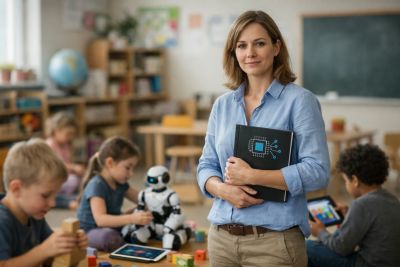
- Nine of the 12 studies (75%) used social robots. Eight of these used only a social robot.
- The NAO robot appeared in 4 studies and the Tega robot in 3. Four other studies tested different AI tools, such as a hologram and a motion-based learning environment.
- The studies came from nine countries or regions. Eight were in the United States or Europe, 2 were in East Asia (Korea and Taiwan) and 2 were in Iran.
Theory behind the tools
- 42% of studies named the zone of proximal development, the idea that children learn best with support just beyond what they can do alone.
- Another 42% relied on the idea that human-like features of a robot or program matter.
- 33% mentioned social learning theory, where children learn by watching and copying others.
Did AI work?
- Eight studies compared an AI group with a group that did not use AI. In 6 of them (75%), the AI group scored significantly better.
- In 1 study (12.5%), a robot reading companion and a human reader led to similar reading comprehension scores, so AI did no worse.
- In 1 study (12.5%), no statistical tests were run. Its descriptive scores showed larger gains in phonological awareness (hearing the sounds in words) for children who used a motion-based environment.
- The authors count AI as effective in 87.5% of the studies, and say that using descriptive results all studies supported it.
Factors that might matter
- Language: Results were similar for children's first language (3 studies) and for other languages (5 studies, all teaching English).
- AI type: Narrow AI (6 studies) always beat the non-AI group. General AI (2 studies) was better in one and equal in the other.
- Outcomes: AI was better than or equal to usual teaching for phonological awareness, speaking, and alphabet knowledge or vocabulary.
- Personalization: Of 2 studies, one found larger vocabulary and sentence-building gains with personalized lessons, tuned to the child's feelings. The other found no extra vocabulary gain from adapting to performance.
- Robot role: In 2 studies, a peer robot worked better than a tutor robot. In one study, children learned more vocabulary with a tutor robot than a tutee robot, but were more engaged with a tutee.
- Greater engagement did not always go along with better learning.
Implications
For teachers
The authors suggest that, where affordable, teachers can add AI tools to lessons to engage and motivate children. They advise choosing tools that personalize lessons, planning carefully so that teaching quality does not drop, and having adults present, because young children's attention is limited and still developing. They also say teachers may need gradual exposure to social robots to feel comfortable with them.
For school leaders and policymakers
The authors argue that personalized AI could help close gaps caused by large classes and by differences in home language environments linked to family income. This is a reading of the results, not something the 12 studies tested directly. Because the evidence base is small, a sensible reading is to try these tools on a small scale and track results before buying widely. The authors themselves say more research is needed before AI can be used with more certainty.
For developers and researchers
- Design tools that can use personalization based on feelings as well as on performance, since that was the version linked to larger learning gains.
- Use the robot's autonomous and adaptive features. The authors note that many robot studies used a person to control the robot, which does not test what the AI itself can do.
- Run proper statistical comparisons between AI and usual teaching.
What to watch out for
The review does not show that AI beats a skilled human teacher. Several studies compared AI with a different activity, and some found only equal results. Parents and teachers should treat AI as a possible add-on for repetitive practice, not as a replacement for adults.
Limitations
The authors list limits of their own review. Only 12 studies qualified, which limits how far the findings apply. The studies spanned about a decade, from 2011 to 2021, because the sample was gathered in early 2021. AI has moved quickly since then, so newer tools are not covered. The search was also limited to English, so relevant studies in languages such as Ukrainian and Chinese were left out.
The studies had their own limits. Only 8 of the 12 stated any limitations. Of those, 4 raised study design issues, such as short interventions (37.5%) and weak measures, including children's self-report surveys about engagement (37.5%). 4 raised issues with the intervention, for example covering only two speech acts or limited personalization. 2 pointed to small samples.
The paper does not mention, but a few other points matter. Counting studies as effective or not hides how big each gain was. "Effective" included results that were no different from usual teaching. Only 2 studies looked at general AI and only 2 at personalization, so those comparisons rest on very little. Most studies used robots in short sessions, so novelty may explain some interest and engagement. The authors do mention a possible novelty effect. Finally, the risk-of-bias check was done by the review authors, and for missing data it could not be fully assessed in most studies.
Future Directions
The authors say more research is needed before AI can be used with confidence in early language learning. They point to several open questions:
- Does an AI tool that works on its own beat human teaching? Many robot studies used a person to operate the robot, so they cannot say.
- Why might learning from AI or a computer model work as well as learning from a person? The mechanisms are unknown.
- How should engagement and learning be linked? Children were more engaged in some studies without learning more. The authors suggest the link may be stronger when a tool responds to both thinking and feelings, and that novelty may play a role.
- Which type of personalization works best, and does combining mental and emotional personalization help more?
- How does AI affect a child's first language compared with a second language? None of the studies looked at both, even though many children were bilingual.
- What happens with newer tools, longer interventions and studies published in languages other than English?
The authors also ask future studies to use proper statistical tests, and to work within what current AI can do.
The bottom line: This review of 12 studies of children aged 3 to 8 suggests that AI tools, mostly social robots, support early language learning at least as well as usual teaching. Among 8 studies with a comparison group, 6 favored AI, 1 found no difference and 1 ran no statistical tests. The evidence is early: few studies, short sessions, small samples and nothing after 2021. Adults can try these tools as a supplement with an adult present, but should not treat them as a proven replacement for teaching.


Comments 0
No comments yet. Be the first to share a thought.
Get new research summaries by email
Every new summary, daily at 8:00 AM Eastern (or weekly if you prefer). Unsubscribe in one click.