
Objective
Small AI robots are showing up in classrooms for young children. They can talk, read aloud and answer questions. Most earlier studies tested robots in controlled settings, with materials picked by researchers. Fewer studies looked at what happens when a robot is used with the real school curriculum, a real teacher and a full class.
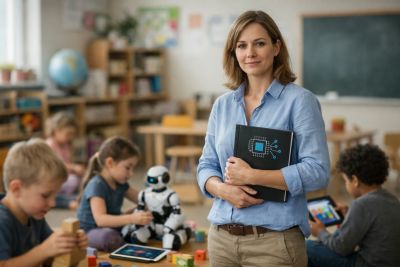
This study looked at one such case. The researchers worked with a teacher to bring an AI-powered social robot (a small talking robot built to interact with people) into a second-grade Chinese language class in a public elementary school in Southern China. They did not test whether children learned more. Their focus was how the robot was fitted into lessons and what happened in the room.
The authors asked three questions:
- How can an AI-powered social robot be integrated into a language learning curriculum?
- What roles does the robot play in the classroom?
- What challenges and future opportunities do the teacher and the children see?
The researchers argued that earlier work often ignored teaching theory. They noted that, in one review of 25 studies of AI tools in elementary schools, 16 did not consider any teaching model. So this study used a structured classroom talk pattern and a way of viewing the classroom as a connected system of teacher, children, materials and technology.
Methods
This was a case study of one classroom. A case study gives a detailed picture of one setting. It can show how something works in practice, but it cannot show whether a tool improves learning, and its results may not apply elsewhere.
Who took part
The children were 44 typically developing, native Chinese-speaking second graders (22 girls and 22 boys) in a top public elementary school in a large city in Southern China. They were chosen by convenience sampling (whoever was available). Most came from upper-middle-class, well-educated families. The teacher had a master's degree in Chinese language teaching, 8 years of experience, and had taught these children since Grade 1. The research ethics committee of The Education University of Hong Kong approved the study, and consent was obtained.
The robot and the lessons
The team chose a small humanoid robot called Fluorite (EZVIZ CS-RK2) that costs about 200 USD. It can scan textbook pages with its camera and read them aloud, explain words, answer questions, sing and dance. It was not made for education. The robot was used in one 35-minute session per week for 8 weeks: one introduction session and seven language lessons from the Grade 2 Chinese curriculum, plus an extra reading book.
The researchers and the teacher planned every lesson together. They used the Initiation-Response-Feedback pattern (the teacher asks, children answer, the teacher gives feedback), with versions that add follow-up questions or restating answers. The teacher alone gave feedback, and the robot supported her. Before class, the team tried each question on the robot at least three times to learn how to ask so that answers suited children.
Data and analysis
Three cameras recorded every lesson, about 320 minutes in all. Two authors and the teacher coded the transcripts to find the robot's roles. Their agreement was 89% at first, and they settled all differences by discussion. After the lessons the teacher answered reflective interview questions in writing, and the children answered in Mandarin. Children's answers were coded in NVivo software, giving 192 concepts and 30 sub-categories. There was no comparison group.
Key Findings
Overall, the robot fitted into the lessons mainly as the teacher's helper. The teacher stayed in charge. The teacher and children named several problems.
How the robot was used
- The planned robot functions fell into three types: knowledge transfer (45 of 100 uses, 45%), learning facilitation (46 of 100, 46%) and emotional support (9 of 100, 9%).
- Reading textbook pages aloud was used 15 times across the seven lesson plans. Other uses were word explanations and question answering.
- Some functions served two purposes at once. For example, reading a text aloud gave information and also kept children interested.
Who talked in class
- The teacher spoke the most, an average of 61.42% of the time.
- Children spoke 27.34% of the time and the robot 15.92%.
- Silence averaged only 3.35%. The authors read this as a lively classroom. The figures come from timing talk in the recordings, not from learning tests.
The robot's roles
- Teaching assistant: 48 of 79 coded role instances (60.76%). The robot read texts in a clear voice and explained words, and the teacher moved around to monitor it.
- Learning companion: 25 instances (31.65%). In one activity the robot read with deliberate mistakes and children found them. In another, children explained a word first and the robot then gave its explanation.
- Social partner: 6 instances (7.59%). It said hello, chatted before lessons, sang and danced.
Teacher-reported challenges
- Workload: The teacher had to learn the robot, plan content ahead and manage a harder class.
- Ethics and security: The robot sometimes interrupted the teacher without knowing it was rude. Its camera could make children feel watched, and a data breach could harm privacy. She also named physical safety and who is responsible if something is damaged.
- Technical limits: The robot handled simple science questions well, such as what a thunderstorm is. It struggled to notice impatience or tiredness. Its built-in resources updated slowly, and some media could not be played because of copyright.
Children-reported challenges
- Functional defects: It sometimes misheard, such as playing the wrong song.
- Teaching errors: It interrupted, sometimes added or skipped words when reading, and gave long explanations that were hard to remember.
- Technical failures: Network problems caused waits, and its reading voice sounded like a machine.
Implications
These points come from a single classroom, so treat them as ideas to try, not proven advice.
Teachers
- The authors suggest planning robot use with a teaching pattern, such as asking, answering and giving feedback, rather than adding a robot with no plan.
- In this study, as planned, the teacher kept control of feedback and used the robot to support her. A sensible reading is that the teacher should stay the main teacher.
- Test the robot's answers before class. The team did this at least three times per question, because the robot was not made for education.
School leaders
- The authors recommend training for teachers on basic operation, teaching uses and troubleshooting, because the teacher reported extra workload.
- They recommend strict data security, following the law, clear codes of conduct, liability agreements with parents and regular evaluation. The robot had a camera and monitoring functions.
Developers and researchers
- The authors argue that robots built for education need better speech recognition, better understanding of emotions, more natural dialogue and fresher teaching content.
- They call for teachers, developers and education researchers to work together.
What the evidence cannot say
The study did not measure language skills, so it gives no basis to claim the robot helped children learn Chinese. Buying a robot because of this study alone would not be supported by the evidence shown here.
Limitations
The authors state several limits, and a few more are clear from the design.
- No learning outcomes. The study did not report children's language ability. It cannot say whether the robot helped or hurt learning.
- One classroom. There were 44 children in one class in one school, from upper-middle-class families with many books and well-educated parents. Classrooms with fewer resources could look very different.
- A robot not made for school. Its speech recognition, content quality and update speed may have affected what happened.
- AI literacy assumed. The authors assumed the children knew about AI because of their home setting but did not measure it.
- The paper does not mention, but the children's feedback was collected after the lessons and the teacher's interview answers were written, so only one teacher's view is shown.
- The paper does not mention, but the coders included the authors and the teacher who planned the lessons, so they may have been inclined to see the planned roles.
- The paper does not mention, but with no comparison class, talk shares and role counts have nothing to be compared against.
The authors tried to reduce the novelty effect (children being excited just because a thing is new) by running an introduction session first. They also reported that the children said they had used AI robots before.
Future Directions
The authors suggest several next steps.
- Does robot-assisted teaching change children's language development? They recommend experiments with control groups that measure and compare learning outcomes.
- Do results hold in other settings? They suggest more classrooms, other age groups, languages, and high-resource and low-resource schools.
- Can robots built for education do better? They call for research and design of robots made for teaching, through teamwork across fields.
- How does children's AI literacy matter? They suggest measuring it directly.
- How should teachers be prepared? The discussion points to professional development and co-design between researchers and teachers.
Open questions also remain from the study. The robot acted as a social partner far less often than as an assistant, so it is unclear how robots could better respond to children's feelings.
The bottom line: In one second-grade Chinese class in Southern China, a small AI robot fitted into eight weeks of lessons mainly as a teaching assistant. It acted less often as a learning companion and rarely as a social partner. The teacher led throughout and planned each lesson with the researchers. The teacher reported more workload, privacy and safety worries, and weak emotional awareness in the robot, and the children noticed mishearing, interruptions and network delays. The study measured no learning results and had no comparison group. It is a useful picture of how this can work, not proof that it helps.

Comments 0
No comments yet. Be the first to share a thought.
Get new research summaries by email
Every new summary, daily at 8:00 AM Eastern (or weekly if you prefer). Unsubscribe in one click.