Objective
Learning a second language takes a lot of practice, and young children are hard to keep engaged. Teachers at the center in this study said that only 60 to 70% of their students took active part in learning and practicing in class. Mandarin Chinese is also a hard language for learners born in the US, so it needs even more practice.
The researchers built a set of computer games to give children extra, enjoyable practice. The games use a Microsoft Kinect camera, a device that watches a person's body and copies their movements onto a character on the screen. The idea comes from embodied cognition, a theory that thinking is closely tied to the body and its movements. Earlier research the authors cite suggests that gesturing helps people learn and remember. The authors reasoned that letting children move, speak and work together inside a story-based game might help language practice.
The paper has two main goals, which the authors treat as hypotheses:
- Games that combine multiplayer play, stories and a Kinect camera can create an engaging place to practice a language.
- Controlling characters with the body through the Kinect could improve learning more than a mouse and keyboard.
This is mainly a system design paper. The study of children is a first, preliminary check of how the games worked in a real classroom. The games are supplements to regular classes, not replacements.
Methods
The paper has two parts: it describes how the system was built, and it reports a small classroom trial. The trial is a preliminary, informal evaluation. It can show how the games were used and how teachers felt about them. It cannot show that the games caused any learning.
The system
The team built four Mandarin practice environments with the Unity game engine. Several players can join from different places over the internet and talk by voice chat. Each can use a Kinect camera or a mouse and keyboard. Environment 1 is based on the story of Cao Chong weighing an elephant, where players practice directions, movements and simple addition. Environment 2 is based on the story of the elephant and the blind men. Each player sees only part of an object and the group must name it, practicing colors, shapes and kinds of objects, using about 50 objects. Environment 3 is a school cafe and Environment 4 is a chat room, both built for longer conversations.
The classroom trial
- Who: 20 children aged 6 to 8 at Bethel Tutoring Center in Rosemead, California, plus two teachers. Most children came from Asian families, and many could understand simple Chinese but none could speak or read it before joining the center.
- When: July 2013, for one month. Before that, the children had taken three months of Chinese classes, twice a week for 30 minutes.
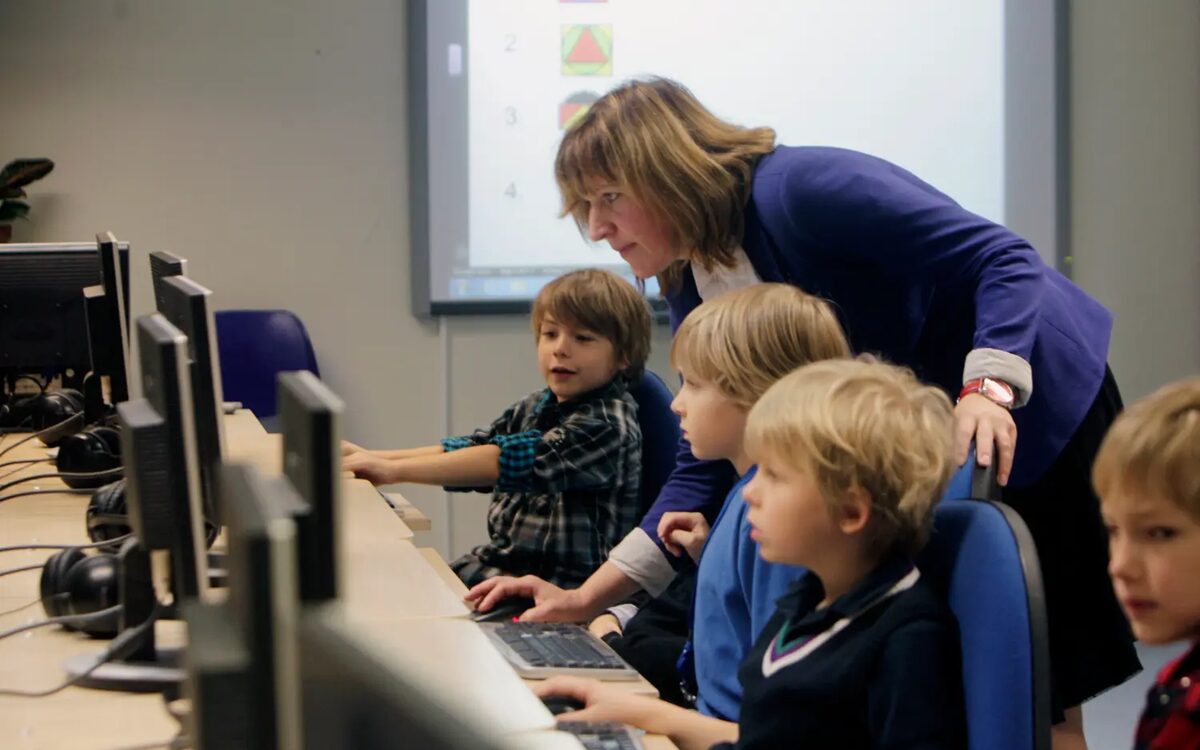
- What: The games replaced the regular Chinese classes. The first 20 minutes of each 30-minute class introduced new words with the system, and the rest reviewed old content. The first week was spent learning the system. Environment 1 was then used for three classes and Environment 2 for the next three.
- Measures: There was no formal exam. The teachers estimated each outcome afterward, comparing the trial month with the first three months of classes. They reported results in a table.
There was no separate comparison group. The paper does not mention ethics approval or consent procedures.
Key Findings
Overall, the teachers reported that the children were more active in practice and learned faster than in regular classes. These are the teachers' judgments, not test scores.
How the games were used
- The teachers decided that Environments 1 and 2 matched the class level. Environments 3 and 4 needed longer conversations, and pushing a table together was too hard for children this age.
- The designers had planned for small groups or individual play. Instead, the whole class worked as one group. One or two children played while classmates helped with the solution. The teachers found this kept the class more engaged.
- Only two laptops with Kinect cameras were available, so typically two children played Environment 1 together. The teacher led the class in saying actions such as picking up and dropping down.
- For Environment 2, the class used one computer with the mouse and keyboard version. The teachers said the children did not find using the Kinect to turn the camera angle attractive. Much of the group talk was in English, and the teachers reminded children of Chinese words they had learned.
- The teachers also used the games to teach other things: adding stone weights in Chinese and English, reading Chinese characters and spelling English words.
Starting point after three months of classes
- About 4 to 5 children (25% of the class) knew about 100 Chinese words.
- 10 children (50%) knew about 50 words.
- 2 to 3 children (25%) knew about 20 words, and 1 to 2 children could say only a few words.
- Most could say a dozen everyday sentences that the teachers had taught them, but could not make up new ones.
What the teachers reported after the trial month
- Most children improved in vocabulary and in building and using sentences.
- More children took part actively in practice. The teachers believed most of the gains came from this higher engagement and from children practicing together more often.
- The number of new words learned was roughly equal to an average earlier month. Recall of old words improved, especially for children who had done poorly before. On average, children remembered 20% more of the old content.
- Because top students had already mastered most words, the class became more even in vocabulary size.
- Pronunciation and sentence organization improved for phrases taught before. By the end, 50% of the children could produce simple two- or three-word sentences such as "move up" and "drop off", which the authors link to Environment 1.
- The teachers said the class learned faster than similar classes in earlier years, though this was not measured.
- Listening comprehension did not change. The authors think one month is too short to see a change.
Teacher response
After the trial, the teachers kept using the games for another month, until most children had mastered the content in Environments 1 and 2.
What the study did not show
The authors say their evaluation gives no clear answer on whether the Kinect works better than a mouse and keyboard. The preference for the Kinect version of Environment 1 suggests it is engaging, but its effect on learning is unknown.
Implications
For teachers
The trial suggests that game-based practice can fit into a short class, with a few minutes of new words in the game and the rest for review. Teachers in the study found that whole-class play worked well when only one or two computers were available. A sensible reading is that you do not need a computer for every child. A teacher who wants to try something similar could pick one or two players and let the class help solve the puzzle, then lead the class in repeating the target words.
The teachers also used the games to teach math, reading and English spelling at the same time. The authors treat this as a useful idea and suggest building it into future versions.
For school leaders
The Kinect camera is described as affordable and easy to install, and the server does most of the computing, so low-end computers can serve as clients. The authors expect little effort to set the system up at schools. Leaders should still treat the results as early. The paper gives no evidence that the games beat regular classes on tested learning.
For developers and researchers
- Children aged 6 to 8 may need simpler tasks than the designers expected. Long conversations and two-person movement tasks were too hard.
- The designers planned small-group play but classrooms used large-group play, so tools should support both.
- Teachers need to adjust content easily. At present, adding new objects means rebuilding the game.
- Features to keep children speaking Chinese instead of English are still missing.
What to be careful about
The evidence is too thin to say that body movement helps children learn language. Parents and schools should not buy or build systems on the strength of this trial alone.
Limitations
The authors call their evaluation preliminary, and several weaknesses limit how far the results can be trusted.
- Teacher estimates, not tests. The authors state that the outcome data are the teachers' subjective estimates, because the classes had no formal exams. Teachers who like a new tool may rate children's progress more generously, so the figures such as 20% more recall are rough.
- No true comparison group. The month with the games was compared with the earlier three months of regular classes for the same children. Children may improve over time anyway, and the summer setting and two-teacher class may also matter. The paper reports no statistical tests.
- Small, single-site sample. Only 20 children at one center in California took part, mostly from families where parents or grandparents could speak Chinese. Results may not hold for other children or settings.
- Only two of four environments tested, and only with ages 6 to 8. The authors say the games may behave differently with solo play, other ages or other environments.
- Kinect not compared with mouse and keyboard. Environment 1 used the Kinect and Environment 2 used the mouse and keyboard, so the study cannot show whether the body-movement feature mattered.
- The short length. One month is too short, in the authors' view, to see changes in listening comprehension.
- The paper does not mention, but the authors designed the system and ran the evaluation themselves, which can bias how results are read.
- The paper does not mention, but novelty may have raised excitement in the first weeks, and a longer study would be needed to tell.
Future Directions
The authors list several next steps and open questions.
- Controlled studies of the Kinect. They plan experiments that compare the mouse and keyboard with the Kinect to see how the form of interaction affects learning behavior and results. They suspect that a learner's age and language skill may change the effect.
- Solo and remote play. Are the games still engaging when children practice alone and meet classmates and teachers only virtually?
- Other environments and ages. They want to test Environments 3 and 4, and extend to older learners, including college students in Chinese classes at Rensselaer Polytechnic Institute, where skill levels can be controlled.
- Objective measures. For future studies with teenagers or college students, they will work with teachers on more objective ways to measure learning.
- Combined learning. They hope to build scenarios that mix Chinese with math or English, as teachers suggested.
- Computer-controlled characters. They want to add configurable AI characters that give a more consistent experience over time.
- Language detection. They are considering a module that spots when a child speaks English and warns them, possibly with characters that look confused.
The bottom line: This paper describes four story-based Mandarin games that use a body-tracking camera, and a one-month classroom trial with 20 children aged 6 to 8. Teachers reported more active practice, about 20% more recall of old vocabulary and no change in listening skills. The evidence is weak: the data are teacher estimates, with no formal tests, no separate comparison group and one small site. The trial also could not tell whether the camera mattered more than a mouse. Readers should see this as a promising design idea that needs controlled studies before anyone treats it as proven.


Comments 0
No comments yet. Be the first to share a thought.
Get new research summaries by email
Every new summary, daily at 8:00 AM Eastern (or weekly if you prefer). Unsubscribe in one click.