Objective
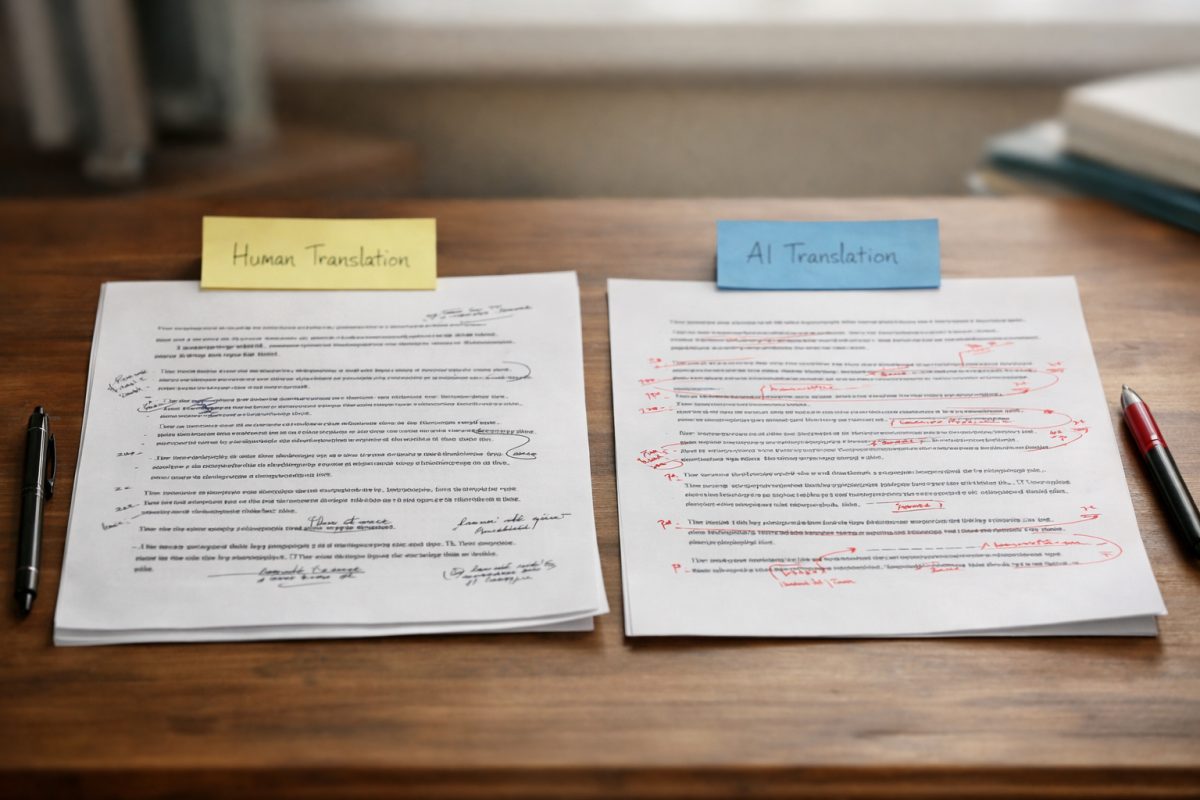
This study wanted to find out how artificial intelligence, especially ChatGPT Translator, affects the way translation students judge and use translations. AI tools like ChatGPT are being used more in translation, so it is important to know if they can match the quality of human translators and how students react to their output. The research focused on two main questions: (1) Is there a link between students' language skills, professional status, and how they judge the quality of AI-generated translations? (2) Can people reliably tell apart professional human translations from AI outputs using only the words and style? This matters because it helps teachers and students know when AI tools are helpful and when they are not. Key terms include ChatGPT Translator (an AI-based language translation tool), human translation (HT), and the BLEU score (a machine-based measure of translation similarity).
Methods
The study used both numbers and written comments to understand how students judged translations. Eight final-year undergraduate translation students from Najran University in Saudi Arabia took part. All were native Arabic speakers, fluent in English and German, and had passed language tests. Five had high English skills (TOEFL above 100), and three had average skills (TOEFL 82). All had passed the Goethe-Zertifikat German exam at levels B2 to C2.
Students were given two German source texts: one technical (from a Bosch battery charger manual) and one literary (from Thomas Mann's 'Death in Venice'). Each text was translated into Arabic and English by both a professional human translator (HT) and ChatGPT Translator (ChatGPT-T). This made four translation pairs: technical-English, technical-Arabic, literary-English, and literary-Arabic. Students read the translations and were asked to say which were human and which were AI-generated. They explained their choices, focusing on language features, and rated the quality of ChatGPT-T outputs using a grading system similar to the BLEU score (a scale from 1 to 10, later changed to 1-100 for comparison). The BLEU score, an automated measure, was also calculated for each AI translation using an online tool. The study looked for links between language skills and judgments, and whether looking at language alone could separate AI and human translations. The study had ethics approval from Najran University's Research Ethics Committee. The paper does not say how long the study lasted or how the students were selected.
Key Findings
The study found several important patterns in how translation students judged ChatGPT and human translations.
Technical texts: ChatGPT nearly matched human translations
- For technical texts, students often rated ChatGPT's output as highly accurate and sometimes hard to tell apart from human translations.
- In the English technical text, five out of eight students mistook the AI translation for the human one, showing that ChatGPT's technical translations were convincing. Three students with high skills could still spot the AI version.
- For the Arabic technical text, seven out of eight students correctly identified the human translation, but the ChatGPT version still received fairly high quality scores (average 57.75 out of 100).
- Students noticed minor errors in ChatGPT's technical translations, such as awkward phrases or inconsistent wording, but found them useful for personal use.
Literary texts: Human translations clearly preferred
- For literary texts, students found ChatGPT's translations much less natural and harder to read. Six out of eight students easily recognized the AI version in English, describing it as "unnatural" and sometimes hard to understand.
- In Arabic literary texts, seven out of eight students correctly identified the AI translation, citing awkward word choices and phrases that made the text confusing.
- Students with higher language skills were better at telling human from AI translations, especially in literary texts. Even students with average skills could often spot the difference when the writing was complex.
Quality scores: Students vs. BLEU metric
- Students' average scores for ChatGPT's technical translations were 67.63 (English) and 57.75 (Arabic) out of 100. For literary texts, scores dropped to 51.38 (English) and 29.00 (Arabic).
- The BLEU scores (an automated similarity measure) were much lower: 9.47 (English technical), 9.12 (Arabic technical), 22.25 (English literary), and 8.25 (Arabic literary). This shows that BLEU and human ratings do not always match, especially for creative texts.
Language proficiency and professional status matter
- Students with higher language skills and more professional experience were more accurate in identifying human translations and gave more detailed feedback on errors.
- Less proficient students focused on surface features and sometimes struggled with complex texts, but could still recognize unnatural language in AI outputs.
Linguistic analysis alone is not enough
- Even skilled students could not always distinguish human from AI translations using only language features, especially as AI output becomes more fluent in technical contexts.
- Both human and AI translations contained errors, and the difference was sometimes hard to spot, especially in straightforward or neutral passages.
Other observations
- Students generally agreed that ChatGPT is useful for technical or informational purposes but not suitable for professional or creative translation without human review.
- Arabic translations by ChatGPT were rated lower than English ones, possibly because there is less data for Arabic.
Implications
For translation students and teachers: The results suggest that AI tools like ChatGPT can be helpful for practice with technical texts, offering quick drafts that students can review and edit. However, students should be trained to spot errors and understand that AI output is not always reliable, especially for creative or culturally sensitive material. Teachers might consider using AI-generated translations as a basis for editing exercises.
For professional translators: ChatGPT and similar tools can speed up work on technical documents, but human oversight is still needed. Translators should use AI as a support tool, not a replacement, and be careful about relying on it for complex or literary texts. The study suggests that editing skills are becoming more important in the profession.
For developers and researchers: The findings show the need for AI translation systems to improve handling of creative and literary language, as well as less-resourced languages like Arabic. Automated metrics like BLEU do not fully measure translation quality, so combining them with human evaluation and other metrics is recommended.
For policymakers and curriculum designers: Translator training programs may need to include more focus on editing, critical evaluation of AI output, and ethical use of machine translation tools. Students should learn both the strengths and limits of AI in translation.
Our reading (not the authors' recommendation): Instructors and students should be aware that small studies like this one may not reflect all learning contexts, and that AI tools should be used with care and human judgment.
Limitations
The study's main limitation is its small sample size: only eight translation students from one university took part. This means the findings may not apply to all translation students or professionals. All participants were advanced students with high language skills, so results could differ with less experienced learners. The study focused on just two types of texts (one technical, one literary) and only three languages (German, English, Arabic), which limits how broadly the results can be used. The paper does not mention, but the use of self-reported ratings and written comments may introduce bias, as students might rate translations differently based on their expectations or familiarity with AI tools. There was no comparison group of professional translators, so the findings reflect student views rather than expert judgment. The BLEU score, while widely used, is known to have limits in measuring real translation quality, especially for creative texts. The study was conducted in one cultural and educational context (Saudi Arabia), which may affect how the results apply elsewhere.
Future Directions
The authors recommend that future studies should use a larger and more diverse group of participants, including both students and professional translators with different language backgrounds. They suggest expanding the range of texts to include more technical, literary, legal, and audiovisual materials, and to cover more language pairs. The study also calls for research into other uses of ChatGPT, such as summarizing and terminology extraction, and for combining BLEU with other evaluation metrics (like METEOR, TER, and human ratings) to get a fuller picture of translation quality. Open questions remain about how well AI tools perform in less common languages, how to best train students in editing, and what kinds of errors are most common in AI vs. human translations.
The bottom line: This study found that advanced translation students often rated ChatGPT's translations as nearly as good as human translations for technical texts, but much less so for literary passages. Students with higher language skills were better at telling human and AI translations apart, especially for complex writing. While ChatGPT can be a helpful tool for technical or routine translation tasks, it is not a substitute for human translators in creative or detailed work. The small sample size means these findings should be seen as a starting point, and more research is needed to guide best practices in translator training and AI use.


Comments 0
No comments yet. Be the first to share a thought.
Get new research summaries by email
Every new summary, daily at 8:00 AM Eastern (or weekly if you prefer). Unsubscribe in one click.