Objective
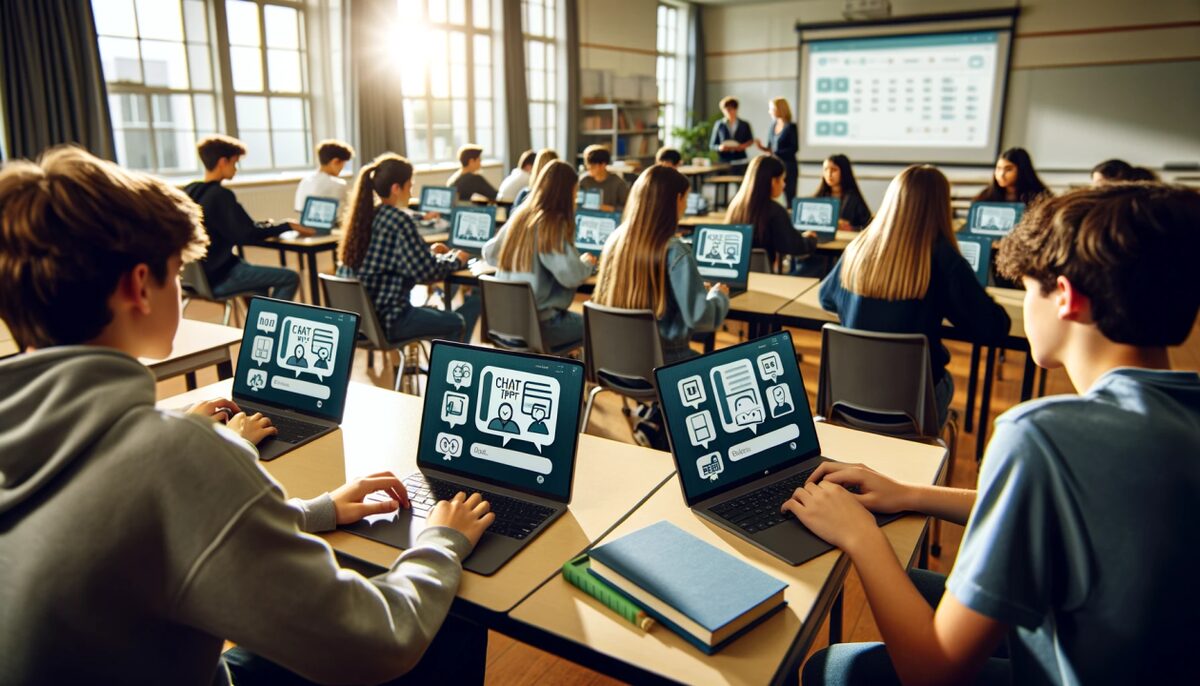
When students investigate a science question in pairs, they need to share what they notice and listen to each other’s explanations. A teacher can help one pair get unstuck, but it can be hard to hear and guide several conversations at once. The researchers asked whether a chatbot could give timely prompts to students discussing a short biology investigation online.
The chatbot, called Clair, was set up to support the conversation between classmates. Its prompts could encourage a student to ask their partner a question or get the pair back to the topic. The authors examined whether pairs using Clair showed more signs of productive discussion than pairs using the same materials without it. They also asked whether students scored differently on an individual biology quiz and whether particular patterns in the conversation went along with quiz scores. These questions distinguish a more active discussion from evidence that students learned more science.
Methods
The study took place in January 2024 during two biology lessons, each lasting between 40 and 50 minutes. It enrolled 140 ninth-grade students from seven classes at two schools in Almelo and Tubbergen, in the Netherlands. The University of Twente’s ethics committee approved the study. Students were told they could decline or withdraw.
The researchers randomly assigned students to pairs and randomly assigned pairs to have Clair in their chat or use the same chat without it. Both groups used Dutch materials on Go-Lab. They read about digestive enzymes, predicted how temperature would affect what happens when saliva and starch mix, and explored the question in an online lab. Partners sat apart and discussed the task in the chat. Students could choose whether to respond to Clair. The chatbot used rules to decide when to send a message based on patterns in the conversation.
The analysis included 55 pairs: 28 with Clair and 27 without it. The researchers excluded pairs that did not complete the final quiz and pairs assigned to Clair that received fewer than two prompts. Each student answered four open-ended quiz questions. The average score could reach 10 points. The researchers also examined chat records for patterns such as one student asking a question and the other responding. They counted how often each pattern occurred, compared groups, and checked for links between the patterns and quiz scores. There was no pretest because the researchers wanted to avoid giving students clues about the material the quiz would cover.
Key Findings
Pairs using Clair showed more signs of sharing ideas, listening to each other, and responding to a partner’s reasoning. The researchers found no clear difference in quiz scores or in a pattern meant to capture deeper reasoning.
What happened in the chat
Students who used Clair spent more time in the chat and exchanged messages with a higher average word count. The researchers excluded messages from Clair itself when they calculated these measures. The extra activity therefore came from the students’ own messages. The analysis then asked whether the exchanges had the kinds of features the researchers wanted to support.
Pairs using Clair showed more patterns of sharing thoughts, listening and responding to a partner, and engaging with a partner’s reasoning. For example, responding to reasoning could involve one student giving an argument, the partner questioning it, and the first student returning with more information. The paper reports effect-size measures of 0.316, 0.319, and 0.320 for those three patterns, respectively. These are measures of the size of the group differences on the chat measures, rather than percentages of students who gained a skill.
The difference was not statistically clear for the fourth aspect the team examined, deepening reasoning. That measure looked for students developing ideas across their messages. The authors report that the “What-if” prompt intended to help with this goal rarely appeared. They suggest the task may not have created many openings for that prompt, but the study did not directly test that explanation.
What students knew afterward
The individual quiz did not show a statistically clear score difference between groups. This matters because more time in a chat and more exchanges with a classmate can be useful outcomes on their own. They should not be read as evidence that students understood the biology better.
Across the data, engaging with a partner’s reasoning went along with stronger quiz scores. When the researchers looked at the two groups separately, a clear link appeared only among pairs without Clair. The other dialogue patterns showed no clear links with the quiz scores in the combined analysis. These results do not show that the chatbot broke a link between discussion and learning. They show that the measured patterns did not relate to scores in the same way in both groups. The authors raise distraction as one possible explanation that needs direct testing.
Implications
The authors suggest that teachers may find a tool like Clair useful for introducing specific ways to take part in a discussion. A prompt can show students how to ask for a partner’s reasoning or how to bring the conversation back to the investigation. Teachers could model those moves before students work in pairs and then ask students to practice them without waiting for the chatbot. That follows the authors’ idea that students might carry the moves into later discussions. The study did not test whether students did so.
A practical reading is to define the goal before using a discussion coach. If the goal is for students to respond to a partner, look for examples of a question, a response, and a follow-up. If the goal is to understand enzymes, use separate questions about what happened and why. Counting more messages will not tell a teacher whether a student understands the science. The authors’ quiz results illustrate why it helps to examine both kinds of evidence.
For developers, the authors recommend prompts for different discussion needs and a design that keeps the conversation centered on the students. A useful test is to inspect when a prompt interrupts the exchange, when students ignore it, and whether it helps the pair continue reasoning together. The findings support exploring a chatbot as a discussion aid in a setting like this one. They give limited grounds for expecting a short chatbot activity to raise knowledge scores.
Limitations
The study covers two lessons in Dutch secondary schools and one activity about digestion. The authors note that the task may have offered few occasions to deepen reasoning. A task that demands comparing competing explanations might produce different conversations. There was also an early technical problem that sometimes triggered unexpected prompts. The authors corrected it and report seeing no obvious disruptions when they reviewed the affected chats.
The paper does not mention, but excluding pairs that received few prompts after assigning them to groups can make the remaining groups less comparable. Those pairs may have behaved differently for reasons that also matter to the results. The comparison therefore gives information about the pairs included in the analysis, with less certainty about what happens whenever Clair is offered to an entire class.
The analysis counted patterns in messages, and the quiz measured knowledge shortly after the activity. Those measures do not show whether students used the same discussion skills later or retained the biology content. The proposed role of distraction was an interpretation. It was not directly measured.
Future Directions
The authors suggest testing Clair with more demanding investigations, giving students more time to get used to it, and exploring prompts that encourage deeper reasoning at more useful moments. For example, researchers could use a problem that calls for several explanations and examine whether prompts help students request evidence and weigh alternatives.
They also call for testing whether handling extra chat messages distracts students from the subject. A comparison could vary when prompts appear and ask whether students understand them, find them relevant, and keep working with their partner. Longer studies could check whether students use the same discussion moves independently and remember what they learned afterward. Including results for all pairs assigned to receive the tool would give schools a clearer picture of what happens when it is offered in an ordinary class.
The bottom line: In a short Dutch biology investigation, students who used Clair showed more signs of sharing ideas and responding to one another. The researchers found no clear advantage on the individual science quiz and no clear difference in the measure of deeper reasoning. The results give teachers examples of ways to support partner discussion. If a school tries a tool like Clair, it can examine the quality of the conversation and check students’ understanding separately. The two measures answer different questions, and both matter when deciding whether the prompts are helping.



Comments 0
No comments yet. Be the first to share a thought.
Get new research summaries by email
Every new summary, daily at 8:00 AM Eastern (or weekly if you prefer). Unsubscribe in one click.