
Objective
To investigate the relationship between AI tool usage and critical thinking skills, focusing on cognitive offloading as a mediating factor, using adults of different ages and educational backgrounds.
Methods
- Mixed-method approach combining quantitative and qualitative data
- Survey with 666 valid responses from participants in the United Kingdom (ages 17 and over, in three age groups), recruited online through social media
- 50 semi-structured interviews
- Analysis using ANOVA, correlation analysis, multiple regression, and random forest regression
- Used Halpern Critical Thinking Assessment (HCTA) tool and Terenzini's self-reported measures
Key Findings
- Higher AI tool usage significantly correlated with reduced critical thinking abilities
- Younger participants (17-25) showed higher AI dependence but lower critical thinking scores
- Higher education levels correlated with better critical thinking skills regardless of AI usage
- Cognitive offloading significantly mediated the relationship between AI use and critical thinking
- Education level moderated the negative effects of AI tool usage on critical thinking
- Random forest regression explained 37% of variance in critical thinking scores
Implications
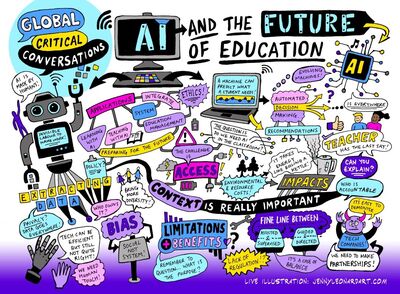
- Need for balanced AI integration in educational settings
- Importance of developing educational strategies that promote critical engagement with AI
- Necessity for clear policy frameworks to guide AI integration in education
- Value of maintaining human cognitive engagement despite AI automation
- Need for teacher training programs on effective AI integration
Limitations
- Reliance on self-reported data
- Potential sample bias: participants were recruited online through convenience and purposive sampling, not at random
- Sample limited to the United Kingdom
- Correlational survey design, so it cannot show that AI use causes weaker critical thinking (the author calls for longitudinal and experimental follow-up)
Future Directions
- Longitudinal studies on long-term effects of AI tool usage
- Cross-cultural studies on AI impact on critical thinking
- Investigation of specific AI tools and their distinct effects
- Development of interventions to mitigate negative impacts
- Research on individual differences in susceptibility to cognitive offloading
The bottom line: This mixed-methods study suggests heavier AI use is associated with weaker critical thinking, partly through offloading thinking to AI. Encourage students to engage critically with AI output; the self-reported, online-recruited UK sample limits generalizing.


Comments 0
No comments yet. Be the first to share a thought.
Get new research summaries by email
Every new summary, daily at 8:00 AM Eastern (or weekly if you prefer). Unsubscribe in one click.