Objective
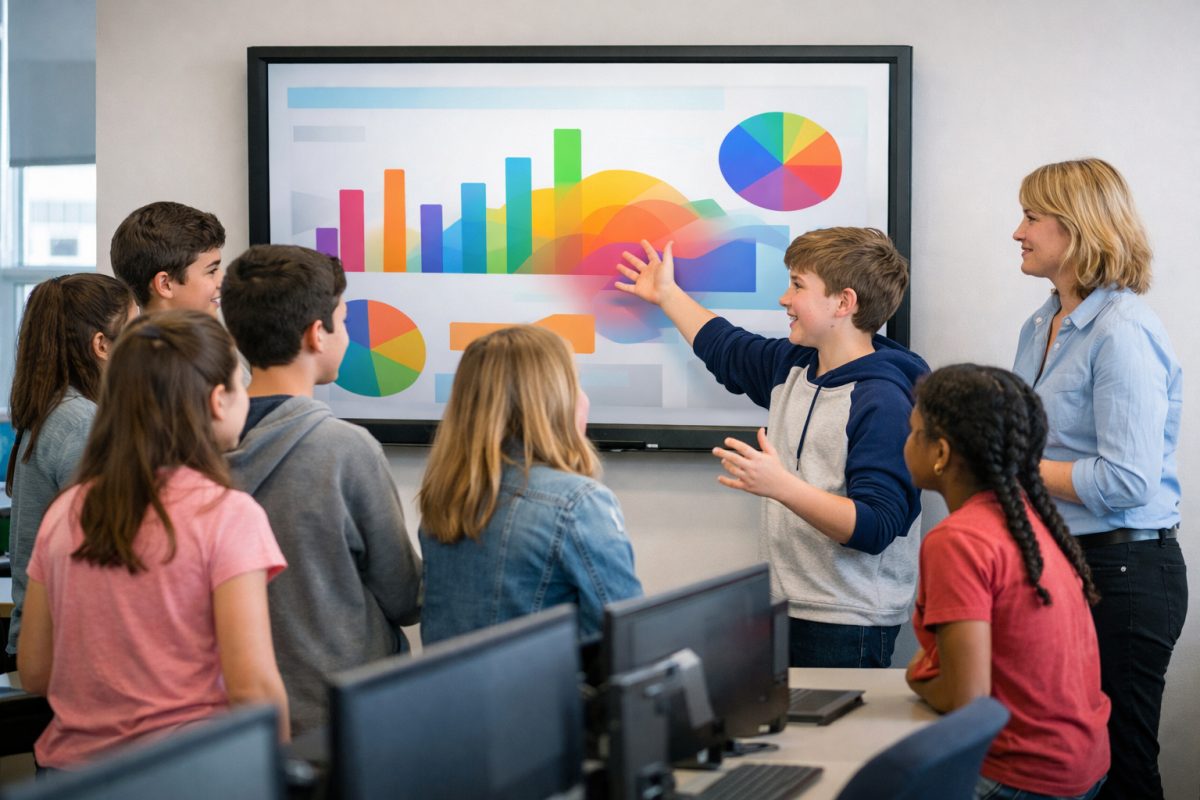
The researchers wanted to find out if using a generative AI tool that lets students create their own interactive visualizations would help eighth-grade students develop computational thinking (CT), motivation, and metacognitive awareness more than traditional methods. Computational thinking includes skills like breaking down problems, finding patterns, designing algorithms, and evaluating solutions. In most classrooms, visualizations are made by teachers or software, so students mainly view or use them, not create them. The study aimed to test if giving students the power to design visualizations using natural language and AI would make a difference in how they learn and think.
The main research questions were:
- Do students using the Generative AI-assisted cognitive authoring system (GACS) show greater improvements in overall and specific CT skills compared to those using conventional methods?
- Does GACS use lead to higher motivation across its main parts (like interest and self-confidence)?
- Does GACS use lead to greater gains in metacognitive awareness (planning, monitoring, evaluating one's own learning)?
Generative AI here means a system that takes students' everyday language descriptions and turns them into interactive web-based visualizations, which students can inspect and revise. The study focused on how this tool, used as a scaffold for student 'cognitive authoring,' might change learning outcomes in a real classroom setting.
Methods
This was a five-week quasi-experimental study with two intact eighth-grade classes (total N = 58) at a public middle school in southern China. One class (28 students) used the Generative AI-assisted cognitive authoring system (GACS) during practice time, while the other (30 students) used conventional representational practice (CRP) with paper, static diagrams, and teacher materials. Both classes had the same teacher-led instruction, learning objectives, and lesson timing. The only difference was in the group practice segment: GSP students created and refined interactive visualizations with GACS, while CRP students completed similar tasks by hand.
The intervention took place in the Information Technology course, focusing on the Internet of Things (IoT) unit. Each session lasted 45 minutes: 20 minutes of teacher instruction and 25 minutes of group practice. The study ran for five weeks: pre-test in week 1, three weeks of intervention, and post-test in week 5. Both teachers had five years of experience, and all students and their guardians gave written consent. No student dropped out.
Data were collected using three established self-report scales: a computational thinking disposition scale (covering decomposition, abstraction, algorithmic thinking, evaluation, generalization), a learning motivation scale (intrinsic goal orientation, task value, self-efficacy), and a metacognitive awareness inventory (planning, monitoring, evaluation). All used Likert-type items. Surveys were given online before and after the intervention. The main analysis used ANCOVA (analysis of covariance) to compare post-test scores between groups, controlling for pre-test scores. Paired t-tests were also used to look at changes within each group. The study had ethics approval (IRB No: 2025-0311).
Key Findings
Overall, students who used the AI tool (GACS) reported bigger gains in computational thinking, motivation, and metacognitive awareness than those using traditional methods, but the improvements were uneven across different skills.
Computational thinking (CT)
- Both groups improved after instruction, but the GACS group (GSP) had higher adjusted post-test scores (3.37 vs. 3.15 on a 5-point scale; FDR-adjusted p = .032, partial η2 = .111).
- The largest difference was in algorithmic thinking (partial η2 = .116): GSP students' scores rose by .42 points, while CRP students' scores rose by .27 points.
- Decomposition and abstraction also improved more in the GSP group, with adjusted means higher than CRP (decomposition: 3.28 vs. 3.22; abstraction: 3.24 vs. 3.18).
- Generalization showed a similar pattern (GSP adjusted mean 3.45 vs. CRP 3.27).
- Evaluation skills improved only slightly and did not reach statistical significance (FDR-adjusted p = .079, partial η2 = .055).
- The pattern was uneven: the biggest gains were in algorithmic thinking, while evaluation lagged behind.
Learning motivation
- GSP students reported higher gains in motivation (adjusted mean 3.42 vs. 3.32; FDR-adjusted p = .037, partial η2 = .097).
- Intrinsic goal orientation (interest in the task itself) had the largest effect (p = .014, partial η2 = .104): GSP scores rose by .50 points, CRP by .15 points.
- Task value (seeing the task as useful) and self-efficacy (confidence in ability) also improved more in GSP, but the difference was smaller (task value: p = .028, partial η2 = .085; self-efficacy: p = .041, partial η2 = .074).
- The biggest motivational gain was in students' interest and sense of purpose, not just their confidence.
Metacognitive awareness
- GSP students reported higher gains in metacognitive awareness (adjusted mean 3.34 vs. 3.28; FDR-adjusted p = .037, partial η2 = .093).
- Planning and monitoring (organizing steps and tracking understanding) improved more in GSP (planning: p = .026, partial η2 = .087; monitoring: p = .018, partial η2 = .097).
- Evaluation (judging quality of one's own work) did not show a significant difference between groups (p = .079, partial η2 = .055).
Other findings
- The improvements in evaluation (both in CT and metacognition) were smaller, possibly because the lessons did not include explicit quality criteria or peer comparison.
- All results are based on self-report surveys, not direct tests or artifact analysis.
Implications
For teachers: The study suggests that letting students use generative AI to create and revise their own visualizations can help them engage more deeply with computational thinking, especially in areas like algorithmic thinking and motivation. Teachers might consider adding activities where students describe and refine their understanding using such tools, rather than only using preset diagrams or code. However, to help students build evaluation skills, teachers may need to add explicit criteria, peer review, or group discussions about what makes a good solution, since the tool alone did not boost these skills.
For school leaders and policymakers: The results show that generative AI tools can fit into regular class periods and may support student-centered learning without major curriculum changes. However, gains were uneven, and the study was small and short-term. Leaders should be cautious about expecting uniform improvements across all skills. More research is needed before scaling up.
For students: Using AI tools to create your own visualizations may help you understand and organize complex concepts, and can make learning more interesting. But you may still need help and feedback to judge the quality of your work.
For developers and researchers: Tools like GACS that focus on student authorship (not just content delivery) may support deeper engagement and some higher-order thinking skills. Adding features for peer comparison, rubrics, or feedback could help address gaps in evaluation skills. The study also shows the need for better ways to measure actual learning, not just self-reported gains.
Our reading (not the authors' recommendation): While generative AI tools can help students externalize and revise their thinking, teachers and designers should not expect them to replace the need for clear standards, peer interaction, or teacher feedback, especially for developing evaluative judgment.
Limitations
The authors note several important limitations. The study took place in one public middle school in southern China, with only two classes (N = 58) and one unit (Internet of Things) in the Information Technology course. Each class had a different teacher, so differences between groups may partly reflect teacher or class effects, not just the tool. The short five-week period means results show only short-term changes, not lasting effects. All outcomes were measured with self-report surveys, not direct tests, project quality ratings, or analysis of the visualizations students made. This means reported gains could reflect increased confidence or fluency, not necessarily deeper or more accurate understanding. No artifact analysis was done, so the actual correctness of students' visualizations is unknown. The study did not analyze differences by gender, prior experience, or other student factors. The paper does not mention, but the lack of random assignment at the individual level and the use of intact classes may limit how much the results can be generalized. The findings are best seen as condition-level associations in this specific context, not as proof of cause and effect for all students or settings.
Future Directions
The authors suggest several directions for future research. Larger studies across different schools, grade levels, and regions are needed to see if these results hold more widely. Future work should use random assignment at the class or teacher level, or rotate teachers across conditions, to separate tool effects from teacher or class effects. Studies should run for longer periods to see if gains last and transfer to other courses or real-world tasks. Researchers should collect richer data, including analysis of the actual visualizations students produce, teacher and peer ratings, and logs of how students interact with the tool. Adding peer assessment, explicit quality criteria, and feedback sources could help address the gaps in evaluation skills and attribution of success. More advanced statistical models could help track how different students respond over time. Finally, future studies should look at how to help students understand and reflect on their own contributions when working with AI tools.
The bottom line: Letting eighth graders use a generative AI tool to create and revise their own interactive visualizations was linked to higher self-reported gains in computational thinking, motivation, and metacognitive awareness than traditional paper-based practice in a five-week classroom study. The biggest improvements were in algorithmic thinking and intrinsic motivation, but gains were uneven, with little effect on evaluation skills. The evidence is limited by the small, single-school sample, short time frame, and reliance on self-reports. Teachers interested in such tools should combine them with explicit criteria and peer feedback to support evaluation skills.



Comments 0
No comments yet. Be the first to share a thought.
Get new research summaries by email
Every new summary each morning, a weekly digest, or a monthly report. You choose, and you can unsubscribe in one click.